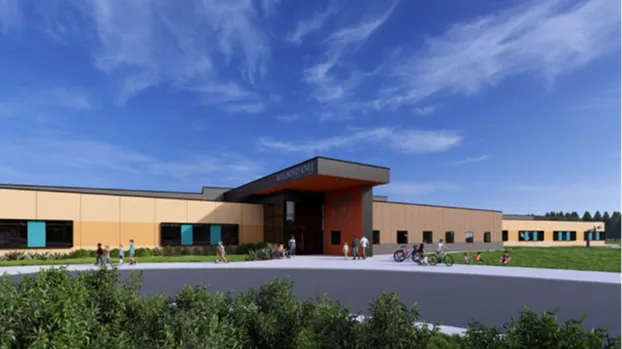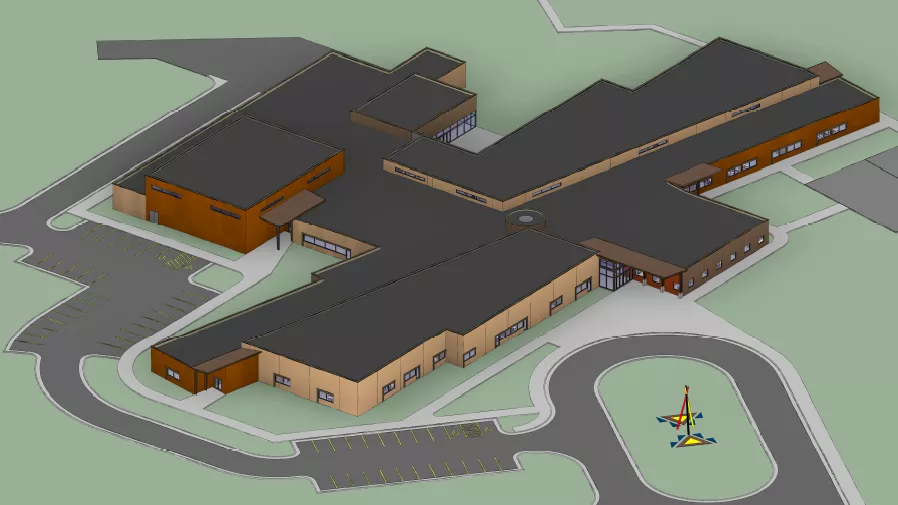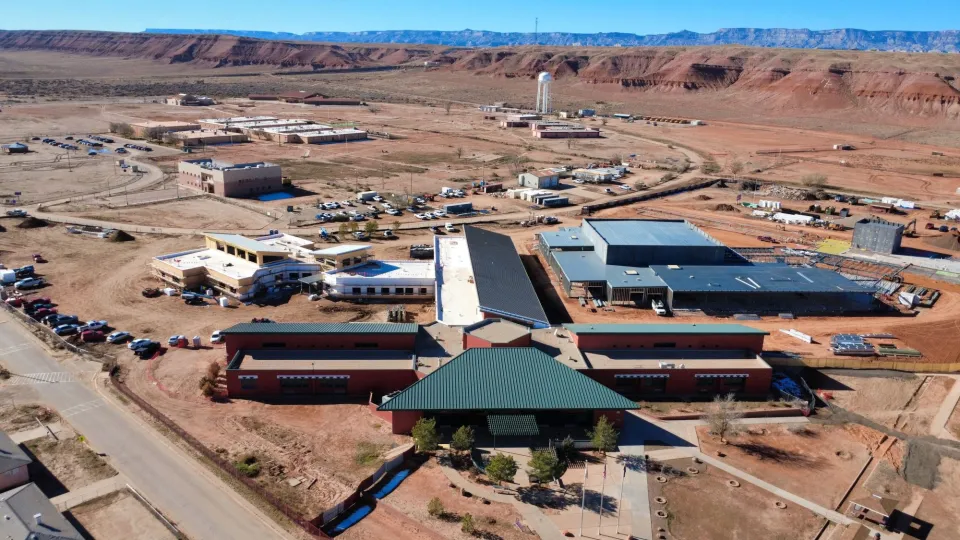
With funding from the Great American Outdoors Act, Many Farms High School campus modernization is creating safer, more functional spaces that benefit the entire community.
Throughout the 2025-2026 school year at Many Farms High School, students and staff have watched as a major construction project progressed on campus. While teachers taught classes, students participated in sports practices and clubs, staff met with parents, and facility maintenance workers performed repairs, nearby construction workers were building a brand-new campus facility for the high school. Talks of a new school had been rumored for years, but the estimated three-and-a-half-year-long construction project finally broke ground in December 2024 to replace the existing, outdated Many Farms High School buildings with a modern, consolidated school building as well as new athletic facilities, housing, and parking lots. This new construction is funded by the Great American Outdoors Act National Parks and Public Land Legacy Restoration Fund (GAOA LRF), which was established in 2020 to address deferred maintenance on public lands and at Bureau of Indian Education (BIE)-funded schools.
Located in the heart of the Navajo Nation in Arizona, Many Farms High School serves as a cornerstone of both education and community life for hundreds of students and the greater Many Farms area. It is a small community where many staff are alumni, or their children attended the high school. However, the existing campus’ academic buildings are spaced far apart, and aging utility systems have led to recurring issues that are disruptive to the school day and require emergency maintenance. GAOA LRF was created to help repair high-priority infrastructure at BIE-funded schools, and BIE selected Many Farms High School as a recipient of GAOA LRF funding to provide the necessary repairs to improve safety, learning conditions, and reduce maintenance and operation costs. This effort marks the first major investment at the site to replace parts of the campus.
Expanding Opportunities for Students
In April, students had the opportunity to tour parts of the new campus nearing completion and to learn more about the construction from the contractor, Tepa Companies. “When we went through the tours, Tepa provided the students a map, and they indicated which areas they were in and the next area we were going to view,” said Principal Louise Donald. “The gym was the highlight…The media center was pretty impressive as well because that's where we started with the construction phase one...so that was more of a finished area. They got to see the classroom spaces and the actual library area. They were able to roam in and out of the spaces openly. And it was really fun to see and view their facial expressions.” The ongoing construction of the new campus has allowed students to see firsthand what a career in construction and the trades looks like, a common path for students after high school.
The new campus will provide larger, modern classrooms and increase the number of dedicated learning spaces to support more students across a wider range of subjects. “Now that they're getting a bigger science room, I know there's going to be a lot more labs where they get hands-on [experience] before they go into college,” said Angel, grade 12. The new school will also have dedicated elective spaces, including an auto shop, an art classroom with additional storage and a new kiln, a library, a computer lab, and a media center, all of which will support exploration of potential career interests through practical, hands-on experience. “It's really benefiting us as Native American kids because it gives us more opportunities to expand our creativity and our thought process on everything. It expands our career possibilities. said Lilia, grade 12.
Outside the classroom, the new campus will improve the overall student experience. With buildings located closer together, students will spend less time getting from one class to the next and more time focused on learning. The project also includes the construction of new athletic facilities, including a basketball court, baseball and softball fields, a wrestling room, and a weight room. The new football field will be surrounded by a track-and-field complex with safer bleachers for fans to cheer on the Lobos. The school will be able to host home games and meets for the first time in its history, reducing the time students spend traveling for away games during the season. The new heated and air-conditioned gymnasium also includes an auditorium stage to support student performances and graduation. “I like the gym and how big it's going to be…There will be three gyms now. So, it's really convenient that they won't have night practices anymore and that it's going to be easier for them to have different sports and they can be in there at the same time,” said Keira, a 2026 graduate, who plays basketball and volleyball currently and previously ran track and field and cross-country.
Enhancing Daily Operations for Staff
Staff were most excited about practical updates that would help them carry out their roles. In the current school, staff share offices, files are not always stored nearby, and offices are spread far apart, making it difficult to find each other for a quick chat. The new school campus provides centralized, private offices with more space, enabling more comfortable meetings with students, their parents, and other staff members.
The new utility systems will provide more reliable heating and cooling throughout the school, allowing temperature customization with each room having its own thermostat, and improving comfort during the school day. For maintenance staff, updated utilities and modern building systems will reduce the need for frequent emergency repairs, allowing them to spend more time on their core responsibilities and routine upkeep. “I'm just happy that a new facility's coming to Many Farms High School, and it is a lot of work dealing with the current school right now, as far as heating, ventilation, cooling systems, water lines, waste lines. I never knew how big an operation it was at Many Farms High School until I worked here…But as far as the new school, just seeing the looks on the students’ faces, they're excited, and they're happy that construction's finally happening right now,” said Jeremy Begay, a maintenance worker and alum of Many Farms High School.
Staff were also able to provide input during the design process for the new school campus, including staff housing, which approximately half of the school staff use. They contributed to key housing design choices, including selecting tile and color schemes, and are now seeing their decisions come to life as construction progresses.
Supporting the Local Community
For a small town like Many Farms, a project like this represents a significant investment in the local economy and provides employment opportunities for community members. “Seeing a new building come up in a small town is really exciting, especially for employment,” said Adrian Crosby-Noble, the school’s business manager and an alum. “The contractors and some of the subcontractors are all about 90-95% Native Americans and probably 60-70% Navajos. I think being near the heart of the Navajo reservation, it’s really significant that we’re offering this opportunity to our community, our people, and especially to our former students. [Many former students] are employed at the construction site, so it’s exciting to see.”
School staff also emphasized the importance of strengthening the campus as a shared space. “I think the community will be very interested in using our facilities, and it'd be a great opportunity for our clubs and our student organizations to benefit financially in regard to hosting,” said Principal Donald. Once complete, the hope is that the improved campus will better equip the high school to host community events, including sports games and meets, basketball tournaments, powwows, song and dance, and other events that bring communities and stakeholders to campus.
Benefits for Years to Come
With all these improvements, staff and students hope the new school will encourage increased enrollment, improve working environments, allow maintenance staff to return to day-to-day upkeep rather than emergency repair responses, and create a better learning environment for students with fewer disruptions to the school day. This project has brought the school community closer together by allowing students to see the work the maintenance and construction staff do every day. “This whole process has brought us together as a team and with the students as well. As maintenance workers, we're not really seen; we're just in the background, and people don't tend to notice what we do. But now students see us more, and they're wondering what we do all day [and] they're getting a sense of our job too, what we do on a daily basis….Maybe they might even look into this kind of field too if they want,” said Gustavo Haudley, a maintenance technician and alum of Many Farms High School.
Although many of the older students will have graduated before the new campus finally opens to students, they recognize how it will benefit those who come after them. “This is a good opportunity for the new generation that is coming in. This generation gets to experience it, but future generations, family, friends, they also get to experience the new school that's going to be built, said Angel, grade 12. And they plan to leave their own legacy at the new school too – “Miss Donald gets her own office. She gets to decorate it. We get to give her our graduation pictures. Next time we visit this school, we're going to go to her office, and we're going to see our pictures,” said Lilia, grade 12.
More About GAOA LRF
GAOA LRF is part of a concerted effort to address extensive maintenance and repair needs on public lands and Bureau of Indian Education–funded schools. Supported by revenue from energy development, GAOA LRF provides up to $1.9 billion per year for five years to improve critical infrastructure, strengthen educational and recreational spaces, and ensure these places can continue serving communities for generations to come. Learn more about BIE's GAOA LRF projects or visit the Department of the Interior’s GAOA website.
Contact
Office of Communications
Bureau of Indian Education Central Office
U.S. Department of the Interior
1849 C Street NW, MIB-3610
Washington, DC 20240
Telephone: 202-941-0789
Email: biecommunications@bie.edu